cosmos.wikisort.org - Spacecraft
Formosat-5 (Formosa Satellite 5; Chinese: 福爾摩沙衛星五號) is the first Earth observation satellite manufactured and operated solely by the National Space Organization, the national civilian space agency of Taiwan. The satellite was launched from a Falcon 9 rocket on 24 August 2017, and placed into a Sun-synchronous orbit at an altitude of about 720 km. Formosat-5 can capture color and more detailed monochrome images, along with measuring the ionosphere plasma's properties.
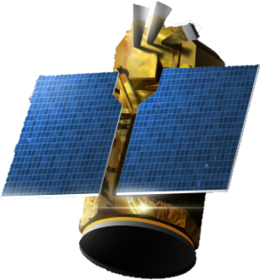 Artist's concept of Formosat-5 | |
| Mission type | Earth observation |
|---|---|
| Operator | NSPO |
| COSPAR ID | 2017-049A |
| SATCAT no. | 42920 |
| Website | Formosat-5 |
| Mission duration | Planned: 5 years Elapsed: 5 years, 3 months, 9 days |
| Spacecraft properties | |
| Manufacturer | NSPO |
| Launch mass | 475 kg (1,047 lb)[1] |
| Dimensions | 1.6 × 2.8 m (5.2 × 9.2 ft)[1] |
| Start of mission | |
| Launch date | 24 August 2017, 18:51 UTC[2] |
| Rocket | Falcon 9 FT |
| Launch site | Vandenberg SLC-4E |
| Contractor | SpaceX |
| Orbital parameters | |
| Reference system | Geocentric |
| Regime | Sun-synchronous |
| Semi-major axis | 7,101.4 km (4,412.6 mi) |
| Eccentricity | 0.0009348 |
| Perigee altitude | 716.6 km (445.3 mi) |
| Apogee altitude | 729.9 km (453.5 mi) |
| Inclination | 98.2892° |
| Period | 99.25 minutes |
| Epoch | 25 August 2017, 12:30:14 UTC[3] |
FORMOSAT programme | |

Spacecraft design
Formosat-5 primary goal is to demonstrate Taiwan's satellite manufacturing capabilities and produce data for various academic research. The satellite is 2.8 m tall, 1.6 m wide octagonal prism body, and weighs about 450 kg. Formosat-5 contains the Optical Telemetry Payload (Chinese: 光學遙測酬載) capturing color and monochrome images, and the Advanced Ionospheric Sounder (Chinese: 先進電離層探測儀) measuring the ionosphere.[4]
The Optical Telemetry Payload is the primary instrument aboard the spacecraft, composed of a telescope and an electrical unit. The telescope uses a CMOS chip designed to see four light wavelengths: blue, green, red, and near infrared. The chip also has a dedicated monochrome sensor with 12-bit color depth. The Optical Telemetry Payload has a 10GB storage device, which can store panoramas that take 8 minutes to capture.[4] Formosat-5 can capture images with a 2-meter resolution in black and white and 4 meters in color.[5]
Formosat-5 also contains a scientific payload, called Advanced Ionospheric Probe, that studies plasma physics and properties in the ionosphere.[6] This instrument can measure plasma composition, density, temperature, and flow rate. The Advanced Ionospheric Probe is expected to be sensitive enough to capture anomalies of the ionosphere before earthquakes.[4]
Other components of Formosat-5 include a power control and distribution unit, heaters, batteries, and foldable solar panels. The power control and distribution unit can output a voltage of 5.2V with a maximum wattage of 50W. Formosat-5's MIPS computer can process 20 million instructions per second, with high-speed data channels.[4]
Operation

Formosat-5 is the National Space Organization's first indigenously developed observation satellite, directed by Chang Ho-pen (張和本).[7][8][9][5]
The satellite was flown from Taiwan to Los Angeles International Airport in the United States on 19 July 2017 via a China Airlines transport aircraft, and arrived at Vandenberg Air Force Base on 26 July.[10][11] Launch took place on 24 August 2017 at 18:51 UTC from Vandenberg Space Launch Complex 4 aboard a Falcon 9 rocket.[2]
In September 2017, Formosat-5 transmitted its first images, which were blurry. A subsequent rescue mission fixed the satellite; however, it is limited to capturing images during good weather.[5]
References
- "Space Programs: FORMOSAT-5: Satellite". National Space Organization. Archived from the original on 26 August 2017. Retrieved 25 August 2017.
- Clark, Stephen (25 August 2017). "Taiwanese satellite rides SpaceX rocket". Spaceflight Now. Archived from the original on 9 August 2018. Retrieved 25 August 2017.
- "FORMOSAT-5: TLE". Space-track.org. 25 August 2017. Retrieved 25 August 2017.
- "福爾摩沙衛星五號 - 國家太空中心". www.nspo.narl.org.tw (in Chinese (Taiwan)). Archived from the original on 25 September 2020. Retrieved 20 October 2021.
- Lin, Chia-nan (24 February 2018). "Taiwanese satellite nails image clarity". Taipei Times. Archived from the original on 27 February 2018. Retrieved 26 February 2018.
- "Space Programs: FORMOSAT-5: Payloads". National Space Organization. Retrieved 25 August 2017.
- "Space Programs: FORMOSAT-5: Program Description". National Space Organization. Retrieved 25 August 2017.
- "FormoSat-5". eoPortal. European Space Agency. Archived from the original on 1 April 2021. Retrieved 21 January 2017.
- "FORMOSAT 5". Gunter's Space Page. Archived from the original on 2 January 2017. Retrieved 21 January 2017.
- Tsao, Yu-fan; Kao, Evelyn; Chen, Christie (20 July 2017). "Taiwan's Formosat-5 satellite arrives in Los Angeles". Focus Taiwan. Archived from the original on 24 August 2017. Retrieved 25 August 2017.
- Goh, Deyana (27 July 2017). "Taiwan's indigenous FORMOSAT-5 arrives at Vandenberg to prepare for SpaceX launch". SpaceTech Asia. Archived from the original on 25 August 2017. Retrieved 25 August 2017.
External links
 Media related to FORMOSAT-5 at Wikimedia Commons
Formosat satellites | |||
|---|---|---|---|
 |  | ||
Future spacecraft in italics. | |||
На других языках
[de] FORMOSAT-5
FORMOSAT-5 ist ein Erdbeobachtungssatellit der taiwanesischer National Space Organisation of the Republic of China (NSPO) aus dem Programm FORMOSAT.- [en] Formosat-5
[ru] FORMOSAT-5
FORMOSAT-5 — оптический спутник дистанционного зондирования Земли, созданный Национальной космической организацией Тайваня (NSPO). Это первый тайваньский спутник такого типа, разработанный и построенный полностью на основе собственных технологических и производственных ресурсов, без привлечения зарубежных подрядчиков[1][2].Другой контент может иметь иную лицензию. Перед использованием материалов сайта WikiSort.org внимательно изучите правила лицензирования конкретных элементов наполнения сайта.
WikiSort.org - проект по пересортировке и дополнению контента Википедии