cosmos.wikisort.org - Spacecraft
Ofeq-7,[5] (also known as Ofek 7 or Offek-7), is part of the Ofeq family of Earth observation satellites designed and built by Israel Aerospace Industries (IAI) for the Israel Ministry of Defense.
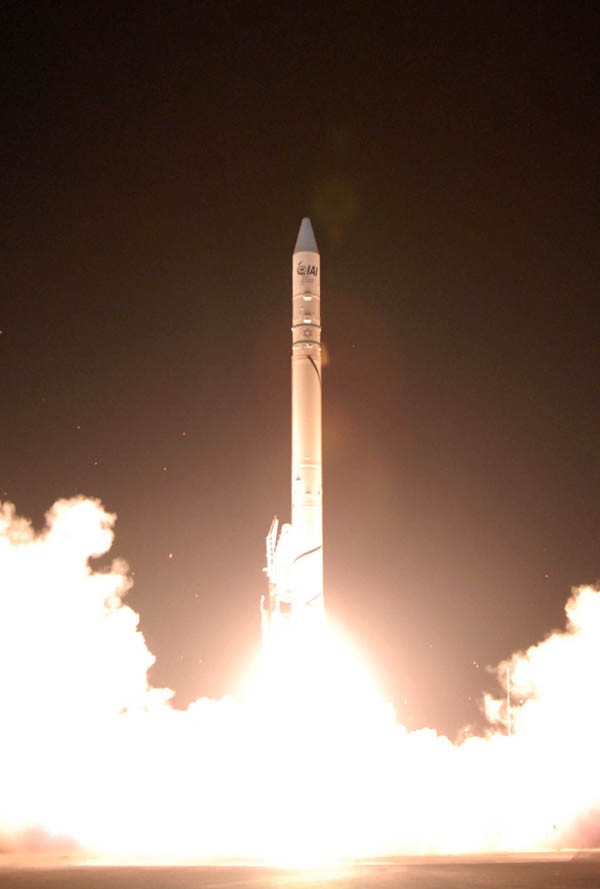 Ofeq-7 launch on a Shavit 2 launch vehicle | |
| Names | Ofek-7 Offek-7 |
|---|---|
| Mission type | Optical reconnaissance |
| Operator | Israeli Ministry of Defence / Tsahal |
| COSPAR ID | 2007-025A |
| SATCAT no. | 31601 |
| Website | https://www.iai.co.il/ |
| Mission duration | 5 years (planned) [1] 15 years and 8 days (in progress) |
| Spacecraft properties | |
| Spacecraft | Ofeq-7 |
| Bus | OPSAT-2000[2] |
| Manufacturer | Israel Aerospace Industries |
| Launch mass | 300 kg (660 lb) |
| Start of mission | |
| Launch date | 10 June 2007, 23:40 UTC[3] |
| Rocket | Shavit 2 (No.7) |
| Launch site | Palmachim Air Base |
| Contractor | Israel Aerospace Industries |
| Orbital parameters | |
| Reference system | Geocentric orbit[4] |
| Regime | Low Earth orbit (Retrograde orbit) |
| Perigee altitude | 339 km (211 mi) |
| Apogee altitude | 575 km (357 mi) |
| Inclination | 141.80° |
| Period | 93.70 minutes |
Ofeq series | |

Launch
The Ofeq-7 was launched by a Shavit 2 space launch vehicle on 10 June 2007 at 23:40 UTC.[3] Equipped with advanced technology and a series of new enhancements to provide improved imagery, it is placed into an elliptical orbit of 300 × 600 km (190 × 370 mi).[6]
Mission
Three days after its launch, on 13 June 2007, IAI MBT Space Division received the first images taken by the satellite. The Ofeq-7 is a follow-on spacecraft to Ofeq-5 that was placed into orbit in 2002.
References

- "UCS Satellite Database". Union of Concerned Scientists. Retrieved 21 November 2013.
- "Ofeq 5, 6, 7, 9". Gunter's Space Page. 21 July 2019. Retrieved 8 May 2021.
- "Launch Log". Jonathan's Space Report. 14 March 2021. Retrieved 8 May 2021.
- "Trajectory: Ofeq-7 2007-025A". NASA. 27 April 2021. Retrieved 8 May 2021.
 This article incorporates text from this source, which is in the public domain.
 - "Display: Ofeq-7 2007-025A". NASA. 27 April 2021. Retrieved 8 May 2021. This article incorporates text from this source, which is in the public domain.
- "OFEQ 7". Heavens Above. Retrieved 8 May 2021.

Earth reconnaissance satellites (excluding Russia and the United States) | |||||||
|---|---|---|---|---|---|---|---|
China  |
| ||||||
France  |
| ||||||
Germany  |
| ||||||
India  |
| ||||||
Israel  |
| ||||||
Italy  |
| ||||||
Japan  |
| ||||||
South Korea  |
| ||||||
Spain  |
| ||||||
Turkey  |
| ||||||
United Kingdom  |
| ||||||
 | This spacecraft or satellite related article is a stub. You can help Wikipedia by expanding it. |
Другой контент может иметь иную лицензию. Перед использованием материалов сайта WikiSort.org внимательно изучите правила лицензирования конкретных элементов наполнения сайта.
WikiSort.org - проект по пересортировке и дополнению контента Википедии